Customer A asks your website’s AI assistant: "What are your shipping options?" Customer B asks "Which of your products will help me reduce shipping costs for fragile items to Europe?"
The first question is straightforward lookup. Your system retrieves shipping information and returns an answer. These are the types of questions RAG can handle well.
But the second question requires thinking and retrieval has to be able to plan, adapt, and iterate. That's where agentic RAG comes in.
This guide will explain what agentic RAG is, what it means for retrieval and how it differs from RAG, and how to evaluate whether or not your organization should leverage it.
RAG: a quick primer
RAG (retrieval augmented generation) works by connecting a large language model to an external knowledge base. When someone asks a question, the system retrieves relevant information from that knowledge base, augments the LLM's prompt with that context, and generates an informed response.
The typical workflow looks like this:
a user query comes in
the system converts it to a vector embedding
it searches for the top matching results in a vector database
it then passes those results to the LLM along with the original query
finally the LLM generates an answer using the retrieved context.
RAG excels at single-turn questions with clear intent. For enterprise organizations, this means use cases like documentation search, FAQ answering, and straightforward knowledge base lookups.
When your content is well-structured and queries follow predictable patterns, RAG delivers fast, relevant answers.
But RAG has a fundamental limitation: it typically uses a fixed retrieval strategy.
If the first retrieval attempt misses the mark or the query requires information from multiple systems, RAG can't adjust. It returns whatever it found on that single pass, whether that's sufficient context or not.
What makes RAG "agentic"
Agentic RAG adds autonomous decision-making to the retrieval process, allowing it to reason, adapt, and act.
It can decompose complex queries into sub-questions, decide which tools or sources to use, refine its approach based on what it finds, and maintain context across multiple steps.
This is fundamentally different from traditional RAG, and comes down to a set of core capabilities: planning and decomposition, dynamic source selection, iteration and validation, and tool use.
Planning and decomposition
Agentic RAG starts by reasoning about what actually needs to be done before any data is fetched. Rather than treating queries as a single lookup, agents break complex questions into executable steps.
This happens dynamically based on what the query actually needs. For example, when an agent receives "Compare our Q3 sales in EMEA to last year," it breaks it down like this:
retrieve current Q3 EMEA data
retrieve prior year Q3 EMEA data
calculate the difference
identify what drove the variance
Dynamic source selection
Not every question should hit the same data store. Based on the query requirements, agentic retrieval systems decide where to retrieve from like vector databases for semantic search, APIs for real-time data, or structured databases for precise lookups. They can combine multiple sources in a single workflow rather than defaulting to one database.
Iteration and validation
Retrieval is rarely perfect on the first attempt, so the system evaluates, iterates, and validates. This is what separates agentic retrieval from static approaches. Agents assess whether retrieved information is sufficient or relevant. If results are incomplete or contradictory, they refine the query or try alternative sources, while maintaining short-term memory across retrieval steps to avoid redundant fetches or build on previous findings.
Tool use
Lots of queries require more than just retrieving. Agentic retrieval can call external tools mid-process to compute, verify, or enrich results as needed.
Need a calculation? The agent can call a calculator API. Need domain-specific data? It can query specialized databases. Need to check inventory levels in real time? It can hit your warehouse management system.
This flexibility means agents can adapt to query needs rather than forcing queries to fit predefined retrieval patterns.
What these capabilities require
To actually enable these capabilities, production implementations of agentic RAG require the right infrastructural components:
persistent memory for storing context across user sessions
tool integration frameworks
observability to track agent decisions.
Without these, agentic retrieval won’t work reliably at scale. But you don’t necessarily have to build that infrastructure from scratch yourself.
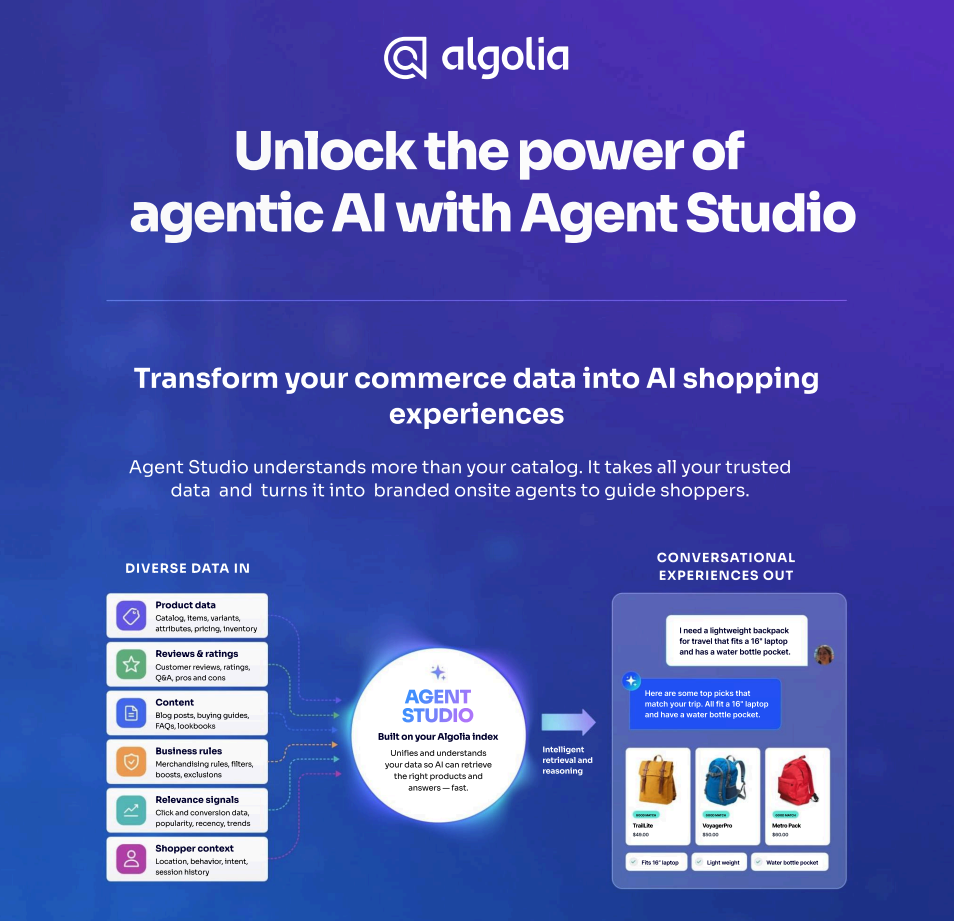
Solutions and agent frameworks like Algolia Agent Studio can handle persistent memory per user and per conversation, orchestrating multiple tools through standards like Model Context Protocol (MCP).
Agentic retrieval vs. traditional RAG: when does the difference matter?
At a high-level, agentic systems trade speed, cost, and predictability for flexibility and depth, while traditional RAG optimizes for fast, controlled retrieval at the expense of adaptability.
Multi-step analysis, cross-system queries, complex decision support
Agentic retrieval isn't "better" in absolute terms. It's better for certain query types, needs, and business contexts. And the added cost and complexity ideally should be justified by how much value there is in handling queries that traditional RAG can’t sufficiently answer. For many straightforward retrieval needs, traditional RAG is a more practical choice.
Differences between agentic retrieval and traditional RAG can show up in day-to-day tradeoffs teams have to manage.
Accuracy vs. speed
Agentic retrieval improves relevance for complex queries but multiplies processing time. Each validation cycle, each additional tool call, each refinement adds latency. Meanwhile, traditional RAG returns results faster, but it may provide incomplete context when queries have multiple facets.
Flexibility vs. predictability
Agents handle novel query patterns without explicit programming. You don't need to anticipate every possible query structure. But this autonomy makes decision paths less transparent. When an agent chooses unexpected sources or takes longer iteration loops, debugging the reason why becomes harder. Traditional RAG gives tighter control but requires manual updates for new query types.
Cost vs. capability
Calling external tools as-needed and iterating results increases compute costs substantially. More API calls, more tokens processed through LLMs for planning and validation. You might see higher token costs compared to traditional RAG for complex queries. Traditional RAG has lower per-query cost but may require more human follow-up when answers are incomplete.
Control vs. autonomy
Agentic systems reduce the need for explicit orchestration rules. They figure out what to retrieve and when. But debugging becomes harder when agents make unexpected choices about which tools to use or when to stop iterating. Traditional RAG requires more upfront logic definition but behaves predictably once configured.
When to choose agentic RAG (and when not to)
Focus on whether the given use case actually benefits from agentic RAG’s capabilities like dynamic planning, iteration, and tool orchestration. The scenarios below outline where agentic retrieval delivers clear value and where traditional RAG is still effective and the more practical choice.
Strong fit scenarios for agentic retrieval
Agentic retrieval performs best when answering a question requires coordination across systems, steps, or evolving context. For example, these are situations where a single retrieval pass is insufficient, and where reasoning about what to retrieve next matters as much as retrieval itself.
Multi-step reasoning requirements
Agentic retrieval excels when a single question requires coordinated access to multiple systems or domains. Instead of hardcoding retrieval logic, agents can decompose the request, fetch the necessary data from each source, and assemble a coherent response. For example:
Product eligibility checks combining specs, inventory, and regional availability
Sales or revenue analysis spanning CRM, finance, and analytics systems
Operational queries that correlate data across business units
Ambiguous or evolving intent
When user intent is unclear or evolves through interaction, agentic retrieval provides flexibility that traditional RAG pipelines lack. Agents learn from the ongoing dialog, allowing them to refine their search strategy as user intent becomes clearer. For example:
Exploratory research and investigative analysis
Sales and account management conversations that build over time
Internal Q&A where users refine requirements iteratively
Dynamic data environments
If information freshness and reliability matter, or sources change frequently, agentic retrieval should be considered. These scenarios often require combining real-time APIs with historical database queries across multiple business systems that update independently. Agentic systems can adapt to shifting source availability and data freshness in ways static retrieval configurations can’t.
Real-time inventory or logistics checks
Financial analysis combining live metrics with historical trends
Cross-functional workflows spanning rapidly changing systems
When traditional RAG works well (or better)
Many retrieval needs don’t actually require agent autonomy or multi-step reasoning though.
When intent is clear, domains are well-defined, and performance or cost constraints dominate, traditional RAG offers simpler, faster, and more predictable behavior.
Single-domain, clear-intent queries
Single-domain queries with clear, predictable intent rarely require agentic complexity.
Use cases like documentation search, FAQ answering, and straightforward knowledge base lookups can often be handled effectively with a well-tuned traditional RAG pipeline.
When retrieval quality can be improved through better data, relevance tuning, or embedding selection, introducing agents can add overhead without actually improving outcomes. For example, that might include things like:
Internal documentation and API reference search
Customer support FAQs and help-center queries
Policy lookups and compliance documentation
Latency-sensitive applications
Latency-sensitive applications may not tolerate the additional delays introduced by agentic iteration. In customer-facing search or real-time user interactions where response time is critical and query complexity is bounded, even small increases in latency can degrade the user experience.
High-volume, low-complexity workloads in particular benefit from the speed and predictability of traditional RAG, where a few hundred milliseconds can determine user satisfaction. This include things like:
E-commerce site search and category browsing
In-app command search or quick-help prompts
Autocomplete and typeahead experiences
Cost-constrained contexts
Cost-constrained contexts must justify every additional dollar spent per query. Agentic retrieval increases compute usage through planning, validation, and tool invocation, which can be difficult to defend in early-stage implementations or under tight budget constraints.
In cases where human follow-up on complex queries is already acceptable and does not create significant operational friction, traditional RAG often remains the more economical choice.
Early-stage product experiments and prototypes
Internal tools with limited usage volume
Support workflows with existing human escalation
Stable, well-defined knowledge domains
Stable, well-defined knowledge domains with mature content repositories are well suited to traditional RAG. When data is well-curated, structured, and changes infrequently, retrieval quality can often be optimized through careful indexing and relevance tuning alone.
In these scenarios, traditional RAG’s simplicity and predictability become strengths instead of limitations. For example:
Employee handbooks and internal policies
Product documentation with controlled release cycles
Regulatory or standards-based reference materials
The hybrid approach
Many organizations start with traditional RAG and selectively layer in agentic capabilities as needed. Routing agents can be configured to direct simple queries to fast RAG pipelines while sending more complex requests to agentic workflows. This preserves compute for straightforward questions and depth for multi-step reasoning.
A staged rollout helps manage risk and operational complexity. Teams often begin by deploying agentic retrieval in internal analyst tools or back-office workflows where latency is less critical, then expand to customer-facing use cases over time.
By applying agentic retrieval only to a subset of high-value query types and keeping traditional RAG as the default, organizations can evaluate impact without committing fully to a more complex system.
Ultimately, the decision should be driven by data. Auditing query logs can reveal how many requests actually require multi-step reasoning or cross-system retrieval. If only a small fraction fall into that category, traditional RAG paired with human escalation may be more cost-effective than investing in full agentic infrastructure.
Real-world use cases where agentic RAG adds value
Agentic retrieval earns its keep in scenarios where the cost of incomplete or incorrect answers outweighs the added system complexity. These real-world use cases highlight where multi-step reasoning and cross-system coordination materially improve outcomes.
Enterprise sales and account management
A sales team member asks: "What's the current contract status for accounts in the automotive sector that are up for renewal in Q1 and have used our premium support?"
This query requires retrieving from CRM for account data, contract database for renewal dates, support ticketing system for premium support usage, and industry classification metadata. An agent can decompose this into parallel retrievals, validate that results align (confirming the same accounts exist across systems), and surface conflicts if data is inconsistent between sources.
Technical support and documentation
Let’s say a customer reports an integration error and provides logs to a support agent to open a ticket. The support agent (or AI assistant) needs to diagnose across product documentation, known issues database, and recent deployment notes.
The agent analyzes log content to identify relevant error codes, retrieves documentation for those specific codes, checks the known issues database for matches, and pulls recent release notes for related changes. Iterative validation ensures the retrieved information is actually relevant to the specific error, not just semantically similar terms that happen to appear in documentation.
Financial analysis and reporting
A finance team asks: "How do our Q3 operating expenses compare to Q2, and what drove the variance?"
This requires retrieving Q3 expense data, fetching the Q2 baseline for comparison, calculating variance, then retrieving detailed line items for categories with significant changes. The agent handles the sequential dependency: it can't identify variance drivers until the baseline comparison is complete.
Ecommerce product discovery
A customer searches for "ergonomic office chairs that fit my budget, ship quickly, and match my home office aesthetic (mid-century modern)."
The agent decomposes this into multiple retrieval needs: ergonomic features from product specs, price range from inventory database, shipping speed from logistics API, aesthetic matching through visual similarity or style tags.
It can iterate if initial results don't satisfy all constraints, perhaps relaxing the budget slightly if no perfect matches exist.
Effective agentic retrieval for product discovery requires a retrieval foundation that understands business constraints (inventory, promotions, business rules) beyond semantic relevance.
Algolia's approach combines hybrid search (keyword plus semantic) with business-aware retrieval capabilities like stock levels, merchandising rules, and personalization. This provides the grounding layer that agents query against, preventing recommendations of out-of-stock items or ignoring profitability considerations.
These examples show where agentic retrieval's complexity pays off. But for simpler queries like "What's our Q3 revenue?" or "Show me office chairs under $500", traditional RAG handles them fine, and at lower cost and latency.
Key considerations before implementing agentic retrieval
Agentic retrieval introduces real operational complexity that goes well beyond prompt design or model selection. Before deploying agents in production, teams need to account for:
cost dynamics
data quality
evaluation strategy
retrieval performance
governance requirements
These considerations often determine whether or not agentic retrieval delivers sustained value and ROI.
Cost and resource implications
Agentic retrieval significantly increases per-query resource consumption due to its iterative nature. Each query may involve multiple LLM calls for planning, validation, and synthesis, along with external tool invocations for data access. For complex queries, it’s common to see 3–5x higher token usage compared to traditional RAG, plus additional API costs for every system the agent touches.
To manage this overhead, teams need explicit controls and optimization strategies:
Set hard iteration limits to prevent runaway loops (for example, a maximum of five retrieval cycles)
Use semantic or result caching for frequently accessed information
Route simple, single-step queries to cheaper traditional RAG pipelines
Monitor cost per query type and optimize agent behavior for high-volume patterns
Beyond runtime costs, agentic retrieval introduces ongoing operational expenses. Teams must budget for observability infrastructure to track agent decisions, tool usage, and failure modes, as well as continuous tuning of prompts, validation logic, and tool definitions.
Data quality and source reliability
Agentic retrieval amplifies existing data quality issues because agents combine information from multiple sources.
Inconsistent metadata, stale records, or low-quality embeddings can undermine the agent’s ability to validate and synthesize results correctly. If one source is accurate and another is outdated, the agent may treat both as equally reliable and produce misleading answers.
Before implementation, organizations should establish strong data hygiene:
Audit data completeness, freshness, and consistency across sources
Define clear ownership and update responsibility for each system the agent can access
Establish quality standards and source-level reliability signals that can be monitored
If your underlying knowledge bases have significant quality issues, those should be addressed first.
Adding agentic logic on top of poor data increases latency and cost without meaningfully improving accuracy.
The Algolia Intelligent Data Kit empowers every team — not just data engineers — to transform and enrich data with no-code tools, instantly boosting the relevance of search and the quality of generative AI results.
Evaluation and success metrics
Traditional RAG metrics like retrieval precision, recall, or semantic relevance don’t fully capture the value or behavior of agentic systems.
Evaluation of agentic retrieval has to extend beyond output quality to include how the agent reasons and operates.
Key metrics to track include:
Task completion rate: Did the agent retrieve enough context to answer the query correctly?
Iteration efficiency: How many retrieval cycles does the agent require before converging?
Source utilization: Are agents selecting appropriate tools and data sources, or defaulting to a single system?
Cost per successful query: Total tokens and API calls relative to business value delivered
For customer-facing applications, direct user feedback on answer quality is essential. A/B testing agentic retrieval against traditional RAG on representative query sets helps quantify tradeoffs in accuracy, latency, and cost, plus determine whether the quality gains justify the additional complexity.
Retrieval infrastructure and performance
Agentic workflows multiply retrieval calls, making underlying retrieval performance critical. Slow vector search or database queries compound across iterations, quickly pushing end-to-end latency beyond acceptable thresholds.
For example, if each retrieval step takes 500ms, three iterations means 1.5 seconds before generation even starts. Because agents may issue multiple retrievals per user query, consistent sub-100 ms performance per retrieval step is often required to keep overall response times reasonable.
Production-grade agentic retrieval depends on fast, reliable infrastructure:
Hybrid search blending keyword precision with semantic understanding, for both head and long-tail queries
Vector similarity search that returns results in milliseconds
Intelligent caching to optimize multi-step and iterative workflows
Algolia's neural hashing approach to retrieval enables semantic retrieval on CPUs (avoiding GPU costs) while maintaining sub-50ms latency.
Its hybrid retrieval combines semantic and keyword approaches to handle the varied query types agents generate. These capabilities are critical because agents making multiple retrieval calls per user query can't tolerate 500ms+ retrieval latency per step.
Security, governance, and compliance
Agentic systems querying multiple data sources must strictly enforce access controls. Without proper safeguards, an agent could inadvertently expose restricted information by synthesizing private data with public sources. For example, combining HR salary data with employee directory information.
Robust governance requires:
Full audit trails of agent decisions and tool invocations
Clear data handling and retention policies for sensitive sources
Role-based access controls that limit which tools and systems agents can use per user type
In regulated domains like legal, financial, or healthcare environments, agent outputs often require human review before action. Well-designed workflows allow agents to retrieve and synthesize information while leaving final decisions or approvals to people.
Enterprise platforms handling agentic retrieval should support compliance requirements like SOC2, GDPR, and CCPA, along with role-based access control for source access and observability for audit trails.
These controls ensure that agent autonomy operates within clearly defined security and compliance boundaries.
Getting started: a practical roadmap
Implementing agentic retrieval successfully comes down to correctly sequencing the work and steps involved, instead of rushing towards the big picture. Teams that see results start small, validate assumptions with real query data, and expand only when the value clearly outweighs the added cost and complexity.
The roadmap below reflects patterns that work in practice.
Start with a pilot in a controlled context
A pilot should focus on a query type where multi-step retrieval clearly adds value and where failures are low-risk. Internal use cases like analyst tools, operational dashboards, or support agent assist workflows are strong starting points because they tolerate higher latency and allow closer human oversight.
These environments also make it easier to compare agentic retrieval directly against a traditional RAG baseline.
Before building, define what success actually means. Without explicit criteria, it’s impossible to determine whether the added complexity is justified.
Qualitative: user trust, clarity of agent reasoning, confidence in retrieved sources
Comparative: measurable improvement over a tuned traditional RAG baseline
Starting with a controlled pilot reduces risk while giving you real data on whether agentic retrieval earns its place in your system.
Assess your data and infrastructure readiness
Agentic retrieval assumes a strong retrieval and systems foundation. Before introducing agents, teams need reliable, low-latency retrieval across all data sources the agent may access, along with clean, well-structured data and consistent metadata.
Observability is equally critical: if you can’t see what the agent is doing, you can’t debug or optimize it.
At minimum, infrastructure readiness should include:
Fast, high-relevance retrieval across structured and unstructured data
Clean data pipelines with clear ownership and update frequency
Monitoring and logging for agent decisions, tool calls, and failures
Well-defined APIs with error handling and fallback behavior
If these foundations are weak, adding agentic logic will amplify existing issues rather than resolve them, leading to higher costs and worse reliability.
Build incrementally
Incremental implementation reduces risk and accelerates learning. Many teams start with routing agents that classify incoming queries and send them to either traditional RAG or agentic workflows based on complexity.
This approach delivers immediate value while keeping system behavior understandable.
From there, expand carefully:
Start with a single agent and a small tool set (two to three tools) focused on one use case
Analyze agent decisions: when does it choose correctly, and when does it struggle?
Measure iteration counts, latency, and cost before expanding scope
Avoid jumping straight to fully autonomous, multi-agent systems where complexity can compound too quickly. Teams should treat agentic retrieval as an evolving capability, adding tools, sources, and autonomy only when metrics justify the change.
Evaluate vendor solutions vs. build-your-own
Before committing to an implementation path, be explicit about what the organization should own versus what they want provided. Building agentic retrieval from scratch requires not just models, but orchestration, retrieval infrastructure, memory management, observability, and governance.
Key questions to ask include:
Do you already have fast, production-grade retrieval infrastructure?
Can you dedicate engineering time to tuning agent behavior over months, not weeks?
Do you need enterprise features like audit trails, RBAC, and compliance controls?
Do you want flexibility to switch LLMs over time?
In practice, many organizations find that retrieval infrastructure and agent orchestration are better sourced from platforms, while domain-specific agent logic remains in-house.
Platforms like Algolia provide retrieval infrastructure, agent orchestration (through Agent Studio), memory management, and observability out of the box.
This lets teams focus on configuring agents for their specific domains rather than building underlying infrastructure. The platform is BYO-LLM, so teams retain control over model selection while leveraging integrated retrieval and tooling.
The bottom line: choose the right retrieval approach
While agentic retrieval is an evolution, it’s not necessarily a universal replacement for traditional RAG. It's a complementary capability suited to specific contexts where the additional cost and complexity deliver proportional value.
Choose agentic retrieval when your queries inherently require multi-step reasoning, cross-system information synthesis, and you have clean data plus a strong underlying retrieval infrastructure to build on.
But opt for traditional RAG when query patterns are predictable and single-domain, latency and cost constraints are tight, and when human follow-up to complex queries isn’t creating operational bottlenecks.
For many organizations, a hybrid approach makes sense. Route simple queries to traditional RAG for speed and cost efficiency, while directing complex queries to agentic retrieval workflows.












.webp)





.jpg)


.jpg)

%20(2).svg)