Customers don’t always search the way product catalogs are structured. When someone types “sustainable running shoes under $150 for flat feet”, they’re communicating constraints, preferences, and tradeoffs.
Today, most ecommerce search systems push that work back onto the user through filters, refinements, and repeated searches despite just 20% of shoppers actually re-attempting a more refined search.
Agentic search takes a different approach by treating search as a reasoning process. The system interprets intent, decomposes complex requests into smaller retrieval steps, evaluates results against constraints like price and availability, and synthesizes outputs that help users make decisions.
This guide explains what agentic search is (and isn’t), where it actually delivers value in ecommerce, how teams can evaluate whether it’s worth the investment, and how to approach implementation.
Why agentic search matters for ecommerce
Merchandisers face a growing disconnect between how customers search and how search engines respond. Shoppers increasingly ask complex, natural questions: "birthday gift for an active 12-year-old" or "breathable business casual for a summer wedding under $200."
Traditional keyword search can't interpret these queries. It either returns nothing or forces users to translate their needs into filter combinations.
When search fails, you lose your highest-intent customers.
And the gap is widening. Conversational AI has reshaped user expectations. Customers who use ChatGPT expect search to understand context and help them decide, not just return a list of links.
Agentic search responds to this shift by transforming search from "find matching products" to "understand intent, plan the right steps, and guide the user to a decision."
For merchandisers, this means higher conversion rates, reduced abandonment, and better product discovery without manual intervention for every edge case.
What agentic search is (and isn't)
Agentic search is a retrieval approach where AI systems analyze user intent, break complex queries into focused sub-tasks, execute searches strategically, and synthesize results to support decision-making. It combines three capabilities:
Reasoning: Understanding what the user actually needs and planning how to find it
Retrieval: Executing targeted searches against indexed content
Synthesis: Combining results into a coherent, useful response
“Agentic AI” broadly refers to systems that don't just find information but act on it as well. An agentic AI system might search travel sites, compare prices, and book the best flight. It handles the entire workflow end to end.
But agentic search stops before the action. It interprets intent, runs multiple searches, and organizes results to support a decision, but the decision itself (and acting on it) stays with the user.
In ecommerce terms: agentic search surfaces the three best product options based on a shopper's constraints. It doesn't add them to the cart or trigger a restock order. The "agentic" label refers to the system's ability to reason about how to search, not to take autonomous action.
How agentic search works
When a shopper submits a complex query, agentic search doesn't treat it as a single lookup. It breaks the request apart, runs multiple focused searches, and assembles the results into something useful, all before the customer sees a response.
Here’s how it works across three stages.
Understanding what the customer actually needs
A query like "outdoor furniture for small patios" carries more intent than the words alone suggest. The system interprets the underlying need, like space constraints, outdoor durability, likely a complete set rather than a single piece, and then uses that interpretation to plan what to search for.
This happens dynamically, driven by the query itself rather than pre-scripted rules. For returning customers, it can also factor in past behavior, like a preference for a particular style or price range.
Finding and ranking the best matches
Instead of running one broad search, the system executes multiple focused searches at the same time: one for compact patio sets, one for space-saving outdoor furniture, one for weather-resistant materials, for example.
Running these in parallel keeps response times fast. Results are then ranked against the original intent instead of just the individual sub-queries, so what surfaces is genuinely relevant to what the customer was asking.
Presenting a useful response instead of just a list
Instead of returning 50 loosely matched results, the system synthesizes findings into one coherent response. It surfaces the most relevant options, applies business rules like inventory availability and margin priorities, and provides enough context for the customer to make a decision without additional filtering.
Together, these capabilities redefine search from a retrieval mechanism into an interactive decision layer that interprets complex shopper intent, narrows product options dynamically, and shortens the path from browsing to purchase.
How agentic search relates to other AI search approaches
Agentic search doesn't replace semantic search or conversational search, but builds on them. Each approach handles a different layer of the search experience, and in practice they work best together.
Semantic search handles meaning: it knows "affordable" and "budget-friendly" are related and returns a ranked list accordingly.
Agentic search adds orchestration: it decomposes complex queries into focused retrieval steps and synthesizes structured results designed to support a decision.
A single shopper journey might touch all three. A customer asks 'what's good for a summer wedding?' and gets a conversational response. As they add constraints ( budget, fabric, dress code, size) the system shifts into an agentic workflow, decomposing the query across categories and surfacing a curated set of options with comparisons. Each layer does a different job, and the value compounds when they work together.
Foundations agentic search depends on
Agentic search is not a standalone solution. It's a layer built on strong retrieval and data foundations. Without these, agentic capabilities degrade or fail.
Fast, hybrid search infrastructure
Agents multiply queries. One user question becomes 3-5 sub-queries. Your base search must be fast and accurate enough to execute these in parallel without degrading user experience.
Hybrid search combines keyword precision (exact SKUs, model numbers) with vector or semantic understanding (natural language intent). If each sub-query takes 200ms and the system runs 4 in parallel, total latency is still ~200ms. But only if your infrastructure supports true parallel execution.
For example, Algolia's NeuralSearch combines keyword, vector, and neural hashing for sub-100ms retrieval even on large catalogs, providing the speed and precision agents need to execute multiple searches without latency spikes.
AI-driven ranking and business rules
Agentic search retrieves results, but which results surface first determines user satisfaction and business outcomes. AI ranking adapts dynamically based on popularity, user behavior, and contextual signals.
Business rules enforce constraints: never surface out-of-stock items, prioritize high-margin products during campaigns, comply with regional restrictions. This creates a tension: agents need flexibility, but businesses need control.
Platforms like Algolia's AI Ranking with merchandising rules allow teams to inject business logic into agentic workflows, ensuring agents respect inventory, margin, and compliance constraints while adapting to user behavior.
Personalization and contextual signals
Agentic search improves when it "knows" the user. Past purchases, category affinities, and session behavior inform sub-query generation. A user interested in running might have "shoes" decomposed into "running shoes" automatically.
Personalization shouldn't override explicit user intent. If someone searches for hiking boots, don't redirect them to running shoes just because that's what they usually buy. Balance is essential.
Personalization engines that surface category affinities and behavioral signals enable agents to tailor sub-queries without requiring users to repeat preferences.
Real-time data and content quality
Agentic search decomposes queries based on what's indexed. If data is stale, incomplete, or inconsistent, sub-queries fail. Real-time indexing ensures inventory, pricing, and availability are current.
Enriched attributes matter too. Detailed specs, consistent taxonomy, and semantic tagging improve the system's ability to decompose and match queries. Missing fields lead to missed matches. Data enrichment tools like Algolia's Intelligent Data Kit normalize attributes, fill gaps, and maintain schema consistency so agents have high-quality content to work with.
Orchestration and tool integration
Agentic search doesn't operate in isolation. It needs to integrate with inventory systems, personalization engines, business rule layers, and downstream applications. Orchestration manages the workflow: clarify intent → search → filter → compare → present options.
Tool calling enables actions: check inventory, calculate shipping, apply discount codes. Defining these tools with explicit schemas (specifying exactly what inputs they accept and outputs they return) prevents agent drift and ensures reliability. Without those contracts, agents can make unexpected decisions that violate business logic.
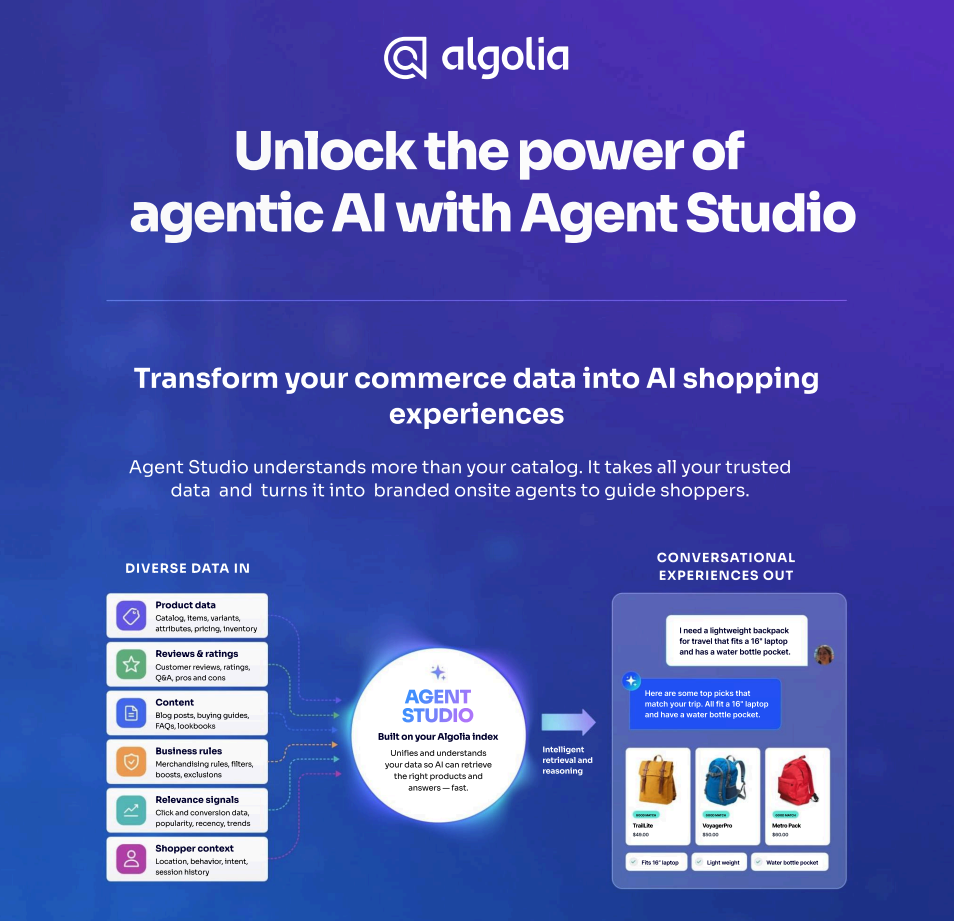
Orchestration platforms like Algolia's Agent Studio provide structured tool calling and multi-step workflow management, allowing agents to reason through product discovery while respecting business constraints. Teams bring their own LLM provider for control and compliance.
Agentic search in action: ecommerce and product discovery use cases
Agentic search proves its value at the exact point where traditional search breaks down: when customer intent is complex, underspecified, or constrained by real-world factors like budget, inventory, and merchandising rules.
These use cases show how it transforms discovery from trial-and-error into a guided experience that aligns shopper intent with business goals.
AI shopping assistants for complex queries
Scenario: "I need an outfit for a summer wedding under $200, business casual, breathable fabric."
With traditional search, users try multiple keyword combinations, filter manually, and often give up. But when agentic search powers AI shopping assistants, the system decomposes the query into sub-queries for breathable dress shirts, summer-weight pants, and business casual wedding attire. It filters by budget and presents coordinated options with comparisons.
Business impact: Higher conversion (users find complete solutions), reduced abandonment (less friction), and increased basket size through cross-category discovery.
Long-tail and underspecified query handling
Scenario: "birthday gift for active 12-year-old"
Traditional search returns zero results or irrelevant generic matches. But agentic search infers relevant sub-queries: active kid’s toys, outdoor sports equipment for age 12, age-appropriate fitness gear, popular gifts for tweens. It surfaces diverse options with explanations.
Business impact: Reduced zero-result rates, improved discoverability of long-tail inventory, and better engagement with browse-mode shoppers who don't know exactly what they want.
Dynamic bundling and complementary recommendations
Scenario: User searches "standing desk."
Traditional keyword search shows desks only. Agentic search recognizes intent beyond a single product. It executes parallel searches for standing desks, ergonomic desk accessories, and adjustable office chairs. It presents the desk with recommended accessories and compatibility notes.
Business impact: Higher average order value, improved cross-sell efficiency, and better customer satisfaction from complete solutions.
Constrained discovery with business rule enforcement
Scenario: User searches "luxury handbags" during end-of-season clearance.
Agentic search decomposes the query, retrieves candidates, then applies business rules: promote clearance items, suppress out-of-stock products, prioritize high-margin brands. Results align with campaign goals without manual merchandising.
Business impact: Inventory optimization, margin protection, and campaign effectiveness without constant manual intervention.
Practical considerations for enterprise organizations
The same capabilities that make agentic search powerful also introduce new dependencies on data quality, infrastructure, governance, and measurement.
Here's what tends to matter most once agentic search moves from experimentation into production.
Data readiness and content quality
Agentic search quality depends on indexed content quality. Missing product attributes, inconsistent taxonomy, and sparse descriptions degrade sub-query effectiveness.
Teams should start with a data readiness assessment to identify gaps that would prevent effective decomposition, particularly around product attributes, categorization, and descriptive fields.
Investment in enrichment pays dividends: richer specifications, well-maintained synonyms, and semantic tagging improve how intent is interpreted and broken down. Schema consistency is especially important, since agents rely on predictable data structures when planning retrieval steps.
Cost and performance trade-offs
Agentic search increases both computational cost and latency by design. A single user query can expand into three to five sub-queries, often in parallel. While parallelism mitigates some overhead, it doesn’t eliminate it — complex queries typically introduce additional latency, often on the order of 100–200 ms beyond traditional search.
Costs also rise from LLM inference for planning, multiple search executions, and semantic re-ranking. Before broad rollout, teams should model expected impact by forecasting query volume, decomposition rates, and per-query infrastructure costs. Caching strategies can reduce redundant work for common or repeated queries, but they do not eliminate the need for careful scoping.
Practical guidance: apply agentic search selectively. Focus first on high-complexity, high-value queries—long-tail or multi-faceted requests where improved discovery justifies the added cost—rather than enabling it universally.
Governance, control, and explainability
Query decomposition is LLM-driven and not directly customizable. This reduces predictability. Implement monitoring: log sub-queries, track decomposition patterns, and identify drift or unexpected behavior.
Business rules should apply after retrieval but before final ranking. This ensures that constraints like brand policies, inventory rules, or compliance requirements are applied consistently, even when an LLM proposes results that would otherwise violate them.
Agentic search should be treated as assistive rather than autonomous. Merchandisers and domain experts need the ability to override, refine, or guide outcomes.
Clear governance protocols matter: define who reviews logs, how often reviews occur, and what thresholds trigger manual intervention or system changes.
Privacy, security, and compliance
Agentic search typically incorporates user context like behavior, preferences, or interaction history, which raises privacy and compliance considerations. Deployments should comply with regulations like GDPR and CCPA, and any internal data handling policies.
LLM selection matters too. Organizations need visibility into where data is processed, how long it’s retained, and who can access it. A bring-your-own-LLM architecture provides flexibility, allowing teams to choose providers that meet regulatory requirements and to switch models without rebuilding search infrastructure. This decoupling is particularly important as compliance expectations and model offerings evolve.
Practical guidance: evaluate LLM provider contracts carefully. Double-check that data residency, retention policies, and usage rights align with your regulatory obligations before deploying agentic search in production.
Limitations and failure modes to plan for
Agentic search does not compensate for poor indexing, missing content, or misaligned business logic. If the indexed corpus lacks the information needed to answer a query, decomposition won’t magically surface it.
In some cases, the reasoning layer can even amplify errors by confidently assembling incomplete or misleading results.
LLM misinterpretation or hallucination can also degrade sub-query quality, especially for ambiguous or poorly phrased requests. Validation layers help, but they don’t eliminate risk. Not all queries benefit from decomposition: simple, direct queries ("Nike Air Max 90") often lead to extra overhead when routed through agentic workflows.
Practical guidance: implement query classification early. Route simple, high-confidence queries to traditional search and reserve agentic search for genuinely complex, multi-faceted requests.
Measurement and continuous optimization
Success with agentic search requires more nuanced measurement than traditional relevance metrics alone. Teams should track business outcomes such as:
conversion rate for complex queries
reductions in zero-result experiences
time to purchase
engagement depth.
These should be paired with operational metrics like latency, cost per session, and average sub-query count.
A/B testing agentic versus traditional search on defined query segments helps isolate impact.
Before scaling broadly, qualitative review is especially valuable: manually inspecting 50–100 agentic search sessions often reveals where decomposition succeeds, where it fails, and what data or logic needs improvement. Continuous optimization should be standard practice.
Checklist: is agentic search right for your organization?
Agentic search is most valuable when:
Your users ask complex, multi-faceted queries regularly
Traditional search produces high zero-result or filter-abandonment rates
You have rich, well-structured product data
Business outcomes (conversion, AOV, engagement) are measurable and improvable
You're prepared to invest in infrastructure, data quality, and governance
Agentic search may be premature if:
Your catalog is small or simple (under 1,000 SKUs with shallow taxonomy)
Most queries are direct and simple ("product name," "brand + model")
Data quality is inconsistent or incomplete
You lack the operational capacity to monitor and iterate
Recommended first steps:
Audit current search performance: identify query types with high abandonment or low conversion
Assess data readiness: review attribute completeness, taxonomy consistency, and content quality
Pilot with a high-complexity query segment: test agentic search on long-tail or multi-category queries where traditional search underperforms
Measure incrementally: compare conversion, engagement, and cost for agentic vs. traditional approaches
Build governance protocols: establish monitoring, override mechanisms, and escalation paths
Getting started with agentic search
Agentic search addresses a narrow but high-impact set of ecommerce scenarios: queries that are underspecified, span multiple categories, or require enforcing constraints like budget, availability, and merchandising rules.
In practice, agentic search works best as an addition to an existing search stack, not a replacement. Traditional search should still handle direct, high-confidence queries. Agentic workflows should be reserved for cases where a single search pass can’t reasonably capture user intent or where manual filtering creates friction.
Whether agentic search delivers value depends less on model choice than on fundamentals: consistent product data, fast retrieval, and clear business rules. Without those in place, agentic search increases cost and latency without improving results.












.webp)





.jpg)





%20(2).svg)