Black Friday used to be simple. Open early, discount aggressively, survive the chaos of a single weekend. However, that is no longer the case. In 2025, Black Friday and Cyber Monday weren’t just bigger; they were fundamentally different. What once existed inside a single day, then expanded into a weekend, has now become a high-stakes, multi-month global event driven by data, AI, and relentless consumer expectations.
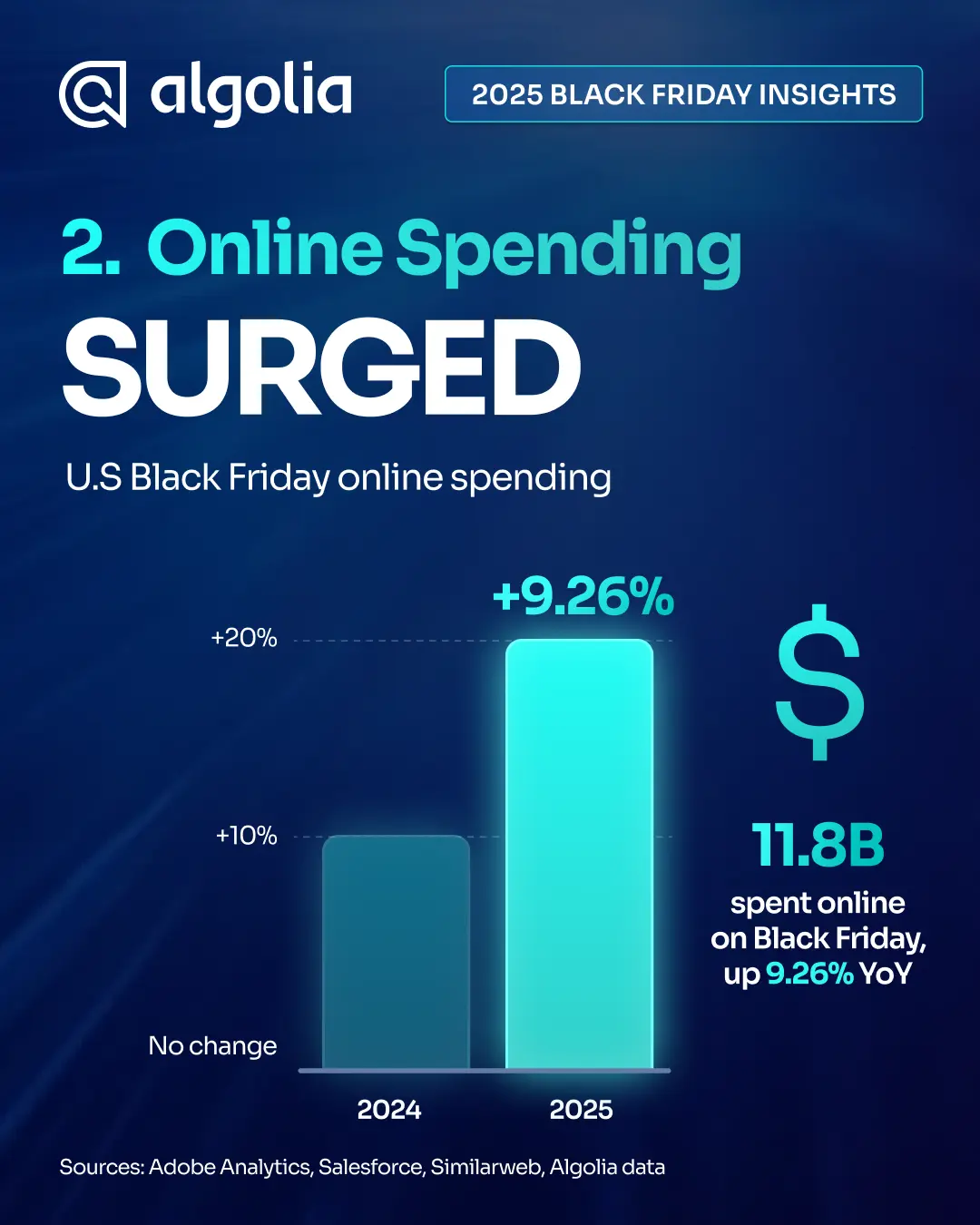
The scale is staggering. U.S. consumers spent $11.8 billion online on Black Friday, up 9.26% year over year (YoY), with more than 87.3 million people shopping online, representing a 6.85% increase. Globally, online spending reached $79 billion in just 24 hours, while Cyber Monday hit $14.2 billion. Mobile commerce continued to grow, rising 7% YoY, and flexible payments surged, with Buy Now, Pay Later accounting for $747.5 million in purchases, up more than 30%. (See sources)
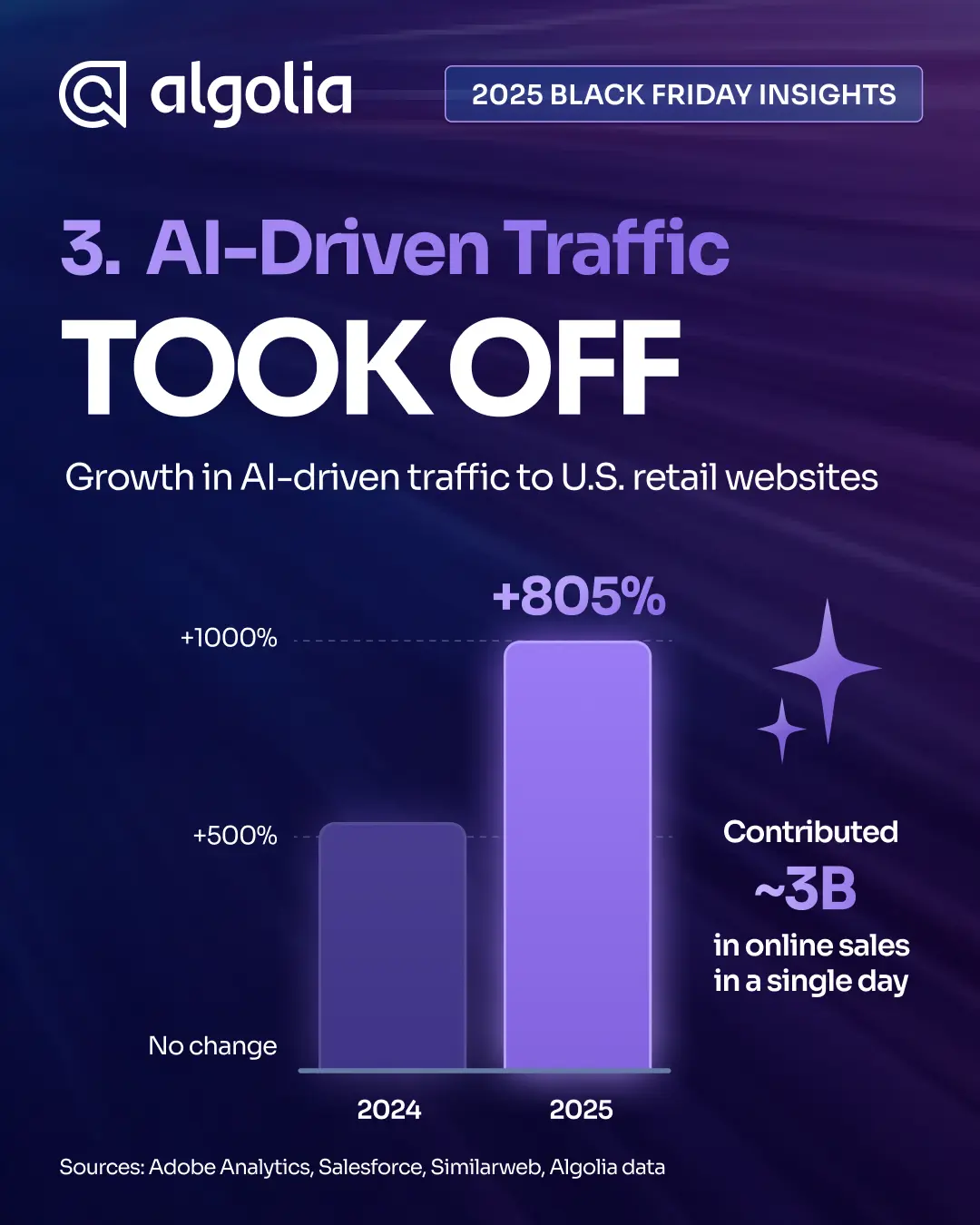
AI-driven traffic to U.S. retail websites skyrocketed by 805%, contributing nearly $3 billion in online sales in a single day. Shoppers arriving from AI-powered tools were 38% more likely to convert, and significantly more engaged, spending more time on site, exploring more products, and leaving less frequently than those from traditional channels.
This development was already underway before Black Friday arrived. In October alone, consumers spent $88.7 billion online (+8.2% YoY), fueled in part by early promotional events like Prime Day, which generated $9.1 billion in just two days. The implication is clear: the path to purchase is collapsing. AI is compressing the journey from discovery to decision.
By April, the frenzy of the past peak season has faded, but its lessons are finally clear. Many retailers are starting their planning now—setting budgets, defining technology strategies, and making the decisions that will determine success in the next peak cycle. Black Friday may happen in November, but in reality, it is won or lost months earlier. Understanding what truly changed in 2025 is not an exercise in hindsight; it is a blueprint for what comes next.
The scale of search: where intent becomes action
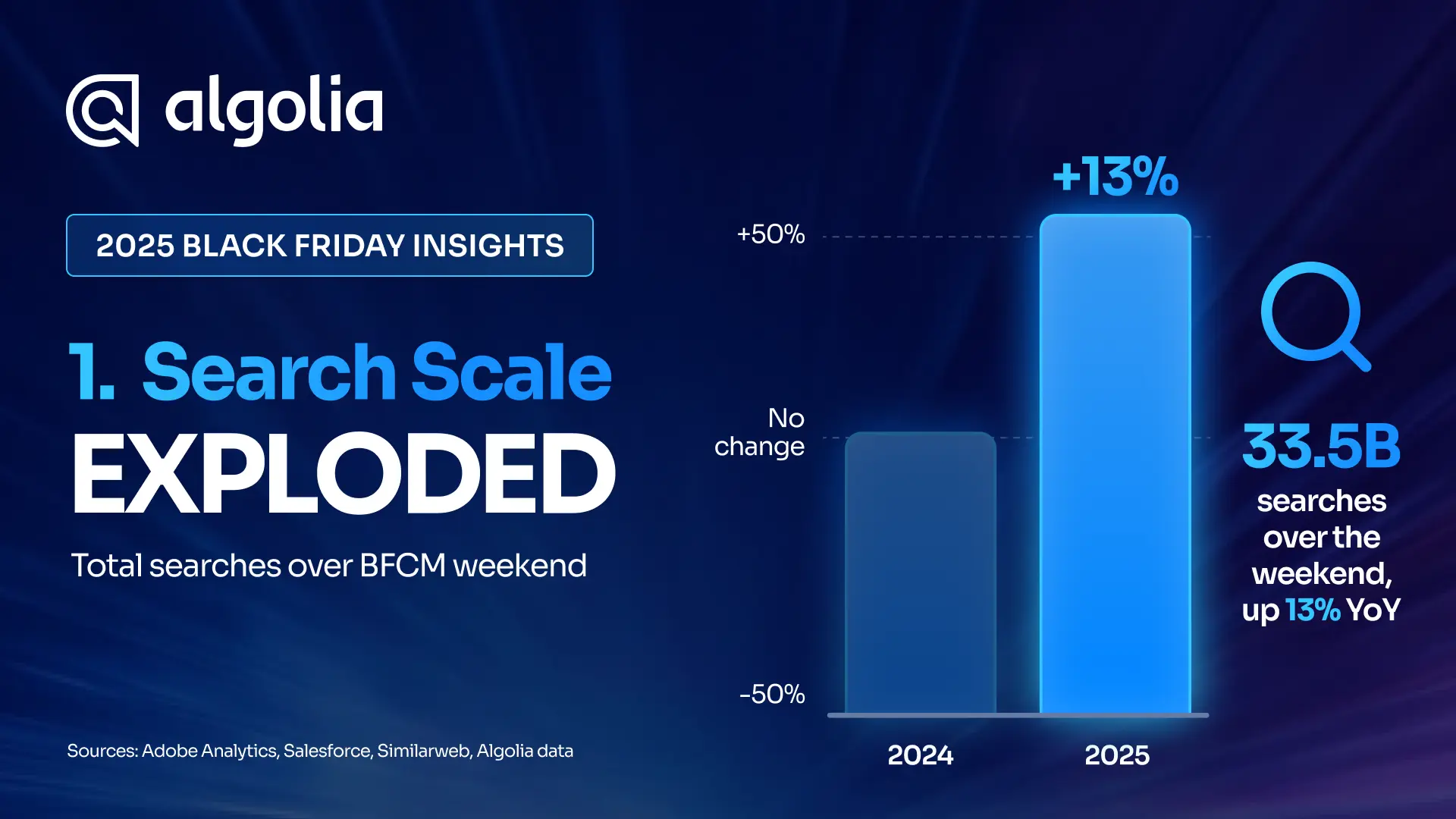
Spending signals demand, but search reveals intent. During the 2025 Black Friday–Cyber Monday period, Algolia processed 33.5 billion searches over the weekend, a 13% year-over-year increase. Black Friday alone accounted for 9.3 billion searches, up 40%, while total queries across November reached 184 billion, all delivered with greater than 99.999% availability. At no point did performance falter; there were no slowdowns, no outages, no lost opportunities.
But scale and reliability, while essential, are only part of the equation. Ultimately, it is relevance that drives conversions. Evidently, Black Friday is no longer a momentary spike, but rather a sustained surge of high-intent activity where every search carries commercial weight.
Why Black Friday still rules retail
While Black Friday remains one of the most important events in retail, its significance has evolved. Retailers are no longer waiting for a single day. They are racing to capture demand earlier, triggering a “pull-forward” effect where consumers spend sooner and competitors scramble to keep up. What used to be a single day is now a season.
This shift brings meaningful operational advantages. Spreading demand reduces the strain on supply chains and pressure on fulfillment networks, thus avoiding breakdowns during what is often the most revenue-critical stretch of the year.
A different kind of shopper
Today’s shopper is faster, more informed, and far less patient—the phrase of the day is “instant gratification”. Nearly half of consumers now use AI tools or are arriving from LLMs and AI assistants having already done their research, compared prices, and generated ideas before they even visit a retailer’s site. Increasingly, they arrive at a retailers’ website knowing exactly what they want, or very close to it.
Their priorities may shift too. In 2025, categories like pet products surged 81%, apparel 51%, and health and wellness 41%, while luxury goods declined sharply by 49% . Consumers prioritized value, practicality, and everyday relevance.
Trust is also emerging as a deciding factor. 72% of consumers say ethical AI will influence where they shop, turning responsible AI usage into a direct driver of preference and loyalty .
The real battleground: discovery
Black Friday has fast become a discovery problem. When billions of searches happen in compressed timeframes, the ability to connect shoppers with the right product instantly determines success. Consumers are not just browsing, they are acting. They are displaying the highest intent to purchase.
This fundamentally changes the role of the website. It has become much more than a place for exploration. It becomes the place where decisions are completed, delivering the right product with zero friction. Any delay, irrelevant result, or extra step introduces risk. And in a high-intent moment, risk translates directly into lost revenue.
Where Algolia changes the equation
Modern shoppers don’t search with perfect keywords. They ask questions, explore options, and may even arrive with AI-informed expectations. Without a strong retrieval foundation, AI struggles to resolve intent reliably. Under peak demand, that quickly turns into missed matches, incorrect recommendations, and lost revenue at the exact moment conversion should happen.
Retrieval underpins the entire experience, ensuring the right product is surfaced instantly, ranked correctly, and grounded in live business data. Algolia’s AI-powered retrieval interprets that intent in real time, delivering results that are contextual, precise, and immediate.
This has a direct business outcome. By surfacing the most relevant products, bundles, and promotions dynamically, Algolia helps retailers increase conversion rates and average order value at the exact moment customers want to act. Its AI-driven search is no longer just improving experience, it is functioning as a revenue engine.
Reliability completes the picture. During peak events, uptime is revenue. Maintaining near-perfect availability under extreme load ensures that retailers can perform when it truly counts.
What retailers should expect in 2026: “A Golden Quarter”
If 2025 was a turning point, 2026 will be an acceleration. The timeline will stretch further. Early October spikes driven by major promotional events are a preview of a future where peak demand begins earlier and lasts longer. The idea of a single “Black Friday event” seems today to be wildly outmoded. Retailers may be better served thinking in terms of a broader season, one called “the Golden Quarter”, as a more fitting reflection of both its extended duration from October to January, and its outsized importance to revenue.
AI will become more decisive. Shoppers are already more likely to convert when arriving from AI-driven experiences. As that trend continues, retailers will see fewer but more valuable interactions, each with higher expectations for precision and relevance.
Traffic patterns will become more volatile. AI agents, influencer-driven demand, and real-time promotions will create unpredictable surges that require constant readiness, not just peak-day preparation.
Relevance will become the primary differentiator. Pricing may attract attention, but precision, delivered in milliseconds, will determine conversion. Retailers that cannot interpret intent and respond in real time will struggle to compete.
And trust will move to the forefront. As AI becomes embedded in shopping journeys, transparency and ethical usage will directly influence their purchasing decisions.
What retailers should be planning for now
The uncomfortable truth is that many retailers are still preparing for the last version of Black Friday. Planning for what comes next requires a switch in both technology and mindset.
Infrastructure must handle sustained, unpredictable demand, not just isolated peaks. And the experience itself must remove friction at every step, combining speed, relevance, and personalization into something that feels effortless.
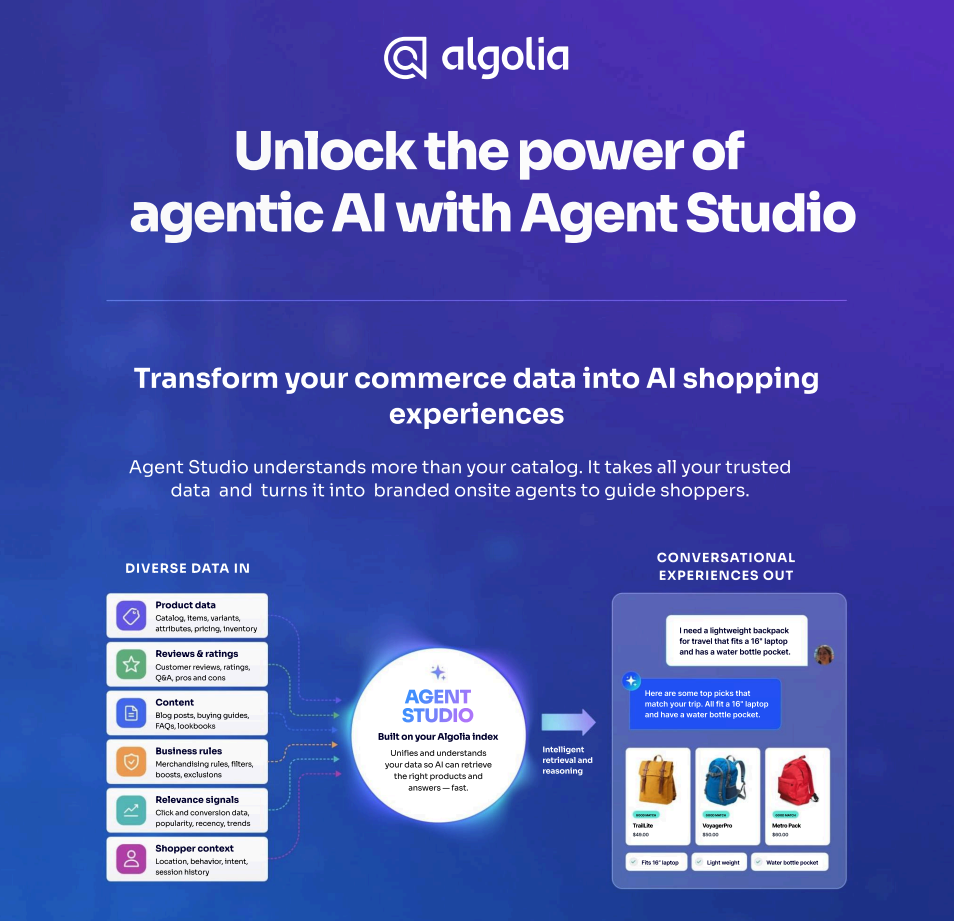
Retailers need to actively leverage agentic, generative, and AI-powered search capabilities to meet these expectations. Traditional search simply cannot keep up with high-intent, AI-informed shoppers. Systems must be able to interpret complex queries, resolve ambiguity instantly, and guide users directly to the most relevant products.
Platforms like Algolia make this possible by using real-time retrieval to power generative and agentic intelligence. In an environment where intent is high and patience is low, improving discoverability is a direct driver of conversion, revenue, and customer loyalty. Black Friday, or the “Golden Quarter,” is now a stress test of everything a retailer has built.
The brands that win are the ones that make it easiest for customers to find, decide, and buy.
“The Golden Quarter” as a glimpse of the future
What happened in 2025 is a preview of what’s to come. Retail is shifting toward a model where discovery is AI-driven, demand is continuous, and infrastructure defines competitive advantage. Black Friday simply compresses these forces into a single, high-pressure environment where weaknesses are exposed quickly.
The takeaway is simple. The point of competition has shifted upstream into AI, and the moment of conversion is now brutally compressed, thus making relevance infrastructure the decisive factor. Retailers are competing on their ability to understand intent, deliver relevance instantly, and operate flawlessly at scale. When they can achieve all three, Black Friday will indeed turn into the “Golden Quarter.”
Sources:
Adobe Analytics / Black Friday Spending Data: U.S. consumers spent a record $11.8 billion online during Black Friday 2025. Adobe Analytics Black Friday Report
Adobe Analytics / October 2025 E-Commerce Growth: October online spending reached $88.7 billion, driven by early promotions and Prime Day events. Adobe October 2025 E-Commerce Data
AP News / Global Black Friday Sales: Global online spending reached approximately $79 billion in 24 hours. AP News Black Friday Sales Coverage
Business Insider / AI Conversion Behavior: Shoppers arriving from AI-powered tools were significantly more likely to convert and engage. Business Insider on AI Shopping Behavior
Adobe Digital Economy Index: Adobe’s broader e-commerce tracking and retail analytics methodology. Adobe Digital Economy Index
eMarketer / Prime Day and October Spending Trends: Prime Day and competitive October promotions accelerated early holiday shopping behavior. eMarketer October Retail Spending Analysis













.webp)





.jpg)



%20(2).svg)