Software development is evolving faster than ever. AI is no longer limited to generating isolated snippets of code. It is heavily influencing how entire features, workflows, and applications come to life. This shift, often called vibe coding, introduces an intent-first development model. Instead of writing detailed technical instructions, teams simply describe what they want in natural language, and AI produces the initial scaffolding that brings those ideas into a tangible state.
When vibe coding is combined with a mature, enterprise-grade search and discovery platform, teams gain both agility and reliability. Algolia provides a stable retrieval engine, proven relevance models, and ready-to-use tooling that prevent AI-generated scaffolding from drifting into brittle or unmaintainable territory. Teams can move quickly with AI while still producing high-quality, scalable experiences that perform consistently for every user.
Vibe coding and Algolia’s role
Vibe coding sits between traditional software engineering and no-code platforms. In the traditional model, developers manually write every class, API route, or data structure. In no-code systems, users drag components visually within a pre-defined framework. Vibe coding creates a new middle ground where both developers and non-developers can simply express intent in natural language. They can request features such as “Create a filtered search with trending categories,” or even, “Draft test cases for our product discovery flow.” Such high-level automation captures the outcome the team wants rather than the specific steps required to build it.
However, despite this automation, human oversight remains necessary. Developers still review the generated output, shape the architecture, and ensure that the final system can scale in real-world environments. This cooperative model blends the speed of AI with the judgment and expertise of engineers. This hybrid approach unlocks several important advantages. Speed of production improves because prototypes and features that once required weeks of development can be delivered in days. Product teams gain accessibility because project managers, merchandisers, and content owners are able to shape functionality directly, without waiting for long engineering cycles. Innovation also increases because developers are no longer weighed down by repetitive or boilerplate work, allowing them to focus on deeper design decisions, performance optimization, and complex challenges that require human insight.
How vibe coding and Algolia work together
Vibe coding only achieves these benefits when it is supported by strong, reliable systems beneath it. If the underlying platform is fragile or inconsistent, the accelerated pace of AI generation can amplify mistakes, produce technical debt more quickly, and create unpredictable user experiences. Speed without a hardened foundation risks turning rapid development into disorder rather than smooth progress.
Algolia handles all of this out-of-the-box so vibe coding doesn’t turn into vibe chaos. Its unified NeuralSearch API merges semantic vector search with exact keyword matching, giving teams both intelligence and precision without juggling multiple engines. Built-in analytics, role-based access, environment isolation, fault-tolerant indexing, and InstantSearch UI components make it production-ready from day one.
1. Intent turns into UI, fast
Vibe coding makes it possible to move from an idea to a functioning interface in a very short time. Instead of assembling components manually, teams simply describe the interface they want, such as requesting a React search page with facets, mobile responsiveness, and auto-suggestion. AI then generates the scaffolding and core logic, while Algolia’s InstantSearch widgets provide the search intelligence that powers filtering, highlighting, and pagination.
2. Strong guardrails keep everything safe
Although AI can create working code quickly, it does not inherently understand organizational security or compliance. Algolia reinforces the development process with structured guardrails:
Scoped API keys:
Limit search access to specific users, roles, or departments
RBAC (Role-based access control):
Defines who can configure search settings, deploy changes, or update relevance
Environment isolation:
Keeps development, staging, and production separate so experiments never affect live users
Together with human oversight, these safeguards create:
Faster development
Stronger compliance
A safer path from prototype to production
3. The retrieval engine that never breaks down
Keyword and semantic search combined.
Developers continue to guide the structure and behavior of the search system by defining schemas, ranking logic, ingestion frequency, and data quality standards. Algolia then executes these rules consistently at scale, unifying semantic search, keyword precision, personalization, facets, synonyms, rules, and analytics into a dependable retrieval engine. AI can draft initial configurations or ingestion scripts, but Algolia ensures the final experience remains fast, predictable, and easy to interpret for both technical and non-technical stakeholders. This foundation keeps search performance strong even as applications evolve.
4. AI generates the glue code, the hidden time saver
A large portion of engineering work involves repetitive but essential tasks such as building search proxies, setting up scoped key utilities, wiring integration layers, or generating CI and CD templates. AI excels at producing these pieces instantly. Developers can refine the output so it aligns with architectural standards and security requirements. By letting AI handle the initial groundwork, teams can shift their focus toward architecture, design, performance, and other high-impact areas rather than spending time on skeleton code.
Real-world use cases: speed without risk
Ecommerce: product discovery that converts
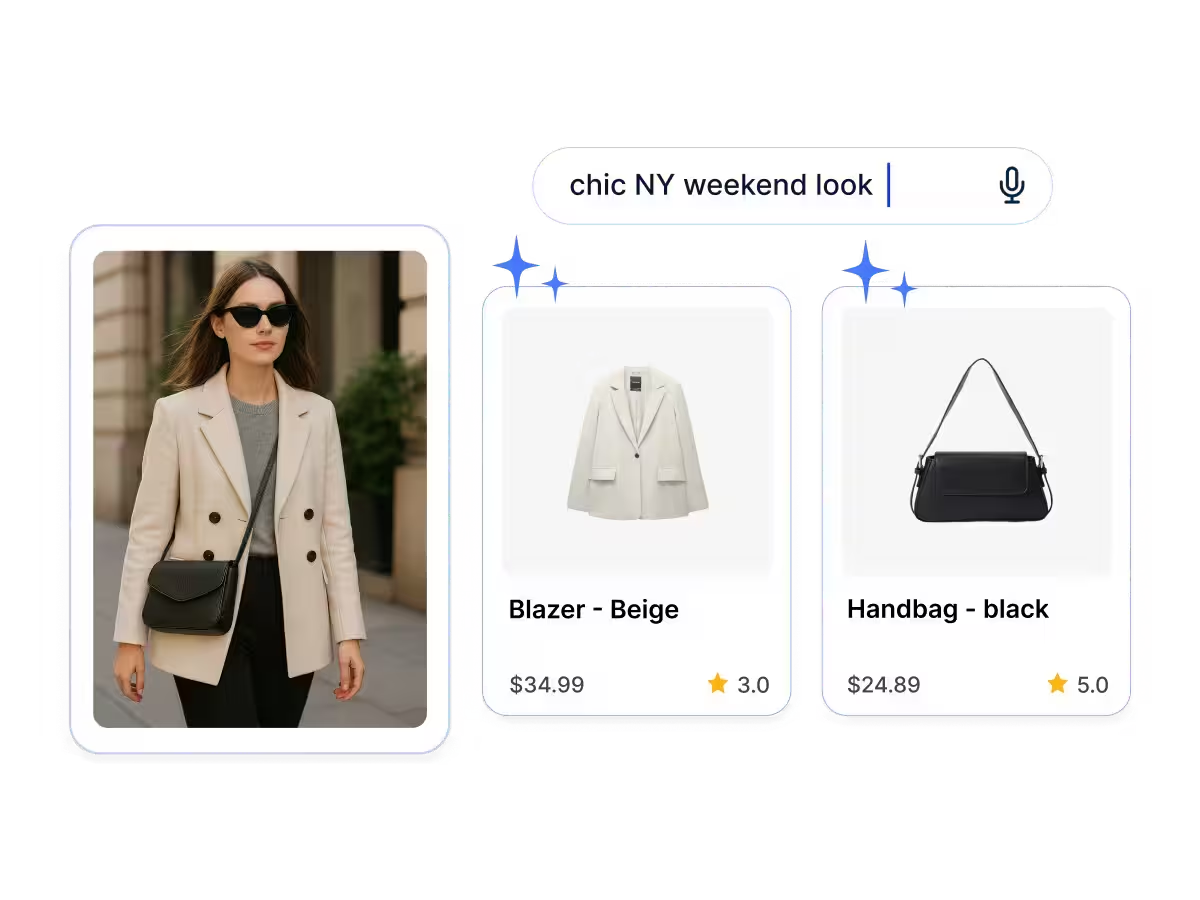
In ecommerce, shoppers expect product discovery to feel fast, accurate, and effortless. When vibe coding is paired with Algolia, retailers can deliver that experience with far less friction. AI helps teams spin up the UI and interaction logic quickly, while Algolia handles the heavy lifting behind search relevance, autocomplete behavior, typo tolerance, and analytics. Seasonal trends or merchandising goals can also be reflected instantly through dynamic promotions.
One of the biggest advantages is that marketers and merchandisers can fine-tune relevance rules, adjust synonyms, or launch campaign-specific promotions on their own. They no longer need to wait for engineering cycles, and Algolia ensures every change is applied consistently and scales smoothly. The combined effect is a search experience that feels more responsive to users, delivers higher click-through rates, reduces “no result” dead ends, and ultimately drives stronger conversions across the storefront.
B2B inventory: precision meets flexibility
In B2B search environments, admin and engineers look up products with unique identifiers like SKUs while customers rely on more general descriptions. Algolia’s hybrid search model handles both needs by blending semantic understanding with precise keyword matching. AI helps teams move faster by generating schema ideas, synonym sets, and ingestion scripts, which simplifies the process of onboarding large and complex catalogs. Together, these capabilities provide accurate results for expert users and intuitive answers for non-experts, creating a search experience that feels right for every type of audience.
Internal knowledge bases: enterprise search without the complexity
Large organizations often deal with scattered documents and inconsistent access to internal information, which makes it hard for teams to find what they need. With vibe coding and Algolia working together, companies can build secure, reliable internal search portals much more quickly. AI helps put together the interface and the integration pieces, while Algolia makes sure sensitive information stays protected through strict access controls and scoped keys. The result is a system that helps employees find information easily, reduces repetitive support requests, and streamlines onboarding and knowledge sharing across the company.
The governance layer: The secret to sustainable vibe coding
Speed is of utmost value, but it is not enough by itself. As AI speeds up the development process, strong governance is needed to keep systems secure, stable, and manageable. Without proper guardrails, rapid AI-generated output can become inconsistent and hard to control. A solid governance layer keeps vibe coding fast, but also reliable. Such key guardrails include:
RACI models for clarity around ownership
Index promotion flows (dev → staging → production)
Rollback strategies for safe experimentation
Security policies around keys, PII, and compliance
Together, these practices make vibe coding scalable and auditable. Governance transforms AI-driven speed into long-term stability, allowing organizations to innovate quickly without sacrificing structure or safety.
Measuring ROI: executive-ready impact
The combination of vibe coding and Algolia does more than streamline development. It produces tangible, measurable improvements across three major dimensions: engineering velocity, product experience, and business performance. These gains demonstrate that faster development does not have to come at the cost of quality. Instead, it creates a cycle where speed, relevance, and impact reinforce each other.
1. Engineering velocity
Time-to-First-Search shrinks from weeks to hours
Developers ship faster with AI handling heavy scaffolding
PMs can run promotions autonomously (≥40% config handled outside engineering)
2. Business outcomes
Revenue lift in ecommerce
Fewer support requests
Significant developer time savings
Faster iteration cycles for experimentation and personalization
Conclusion
The future of development isn’t replacing engineers, it’s amplifying them. Vibe coding turns intent into creation, and Algolia supplies the stable, scalable backbone that transforms fast ideas into production-ready experiences. Want to learn more? Read the full white paper on this topic.









 Other Types





.avif)
%20(2).svg)