An AI shopping assistant helps customers discover products, get personalized recommendations, and complete purchases through natural conversation.
Unlike traditional ecommerce chatbots that are limited to basic Q&As, AI shopping assistants understand context, remember preferences, and can take actions like checking inventory, applying promotions, or guiding checkout.
Shoppers can describe what they want naturally and even open-endedly, like “I’m looking for a blue dress for a gala event under $200”, and get a set of curated, ready-to-buy options in return.
This shift towards AI shopping assistance is quickly gaining momentum; the AI shopping assistant market is projected to reach $84.60 billion by 2034, and platforms like ChatGPT, Google Gemini, and Amazon Rufus are weaving commerce into conversational experiences as AI-driven ecommerce traffic grows.
For ecommerce brands, the opportunity is around enhancing the customer experience and moving more towards conversational commerce.
AI shopping assistants go beyond chatbots by understanding intent and context, applying reasoning, and taking action instead of just answering questions.
Agentic execution is what unlocks real value. Combining generative AI with system-level actions enables personalized, end-to-end AI-assisted shopping experiences.
AI shopping assistants are accelerating conversational commerce, enabling customers to express intent in natural language rather than navigating rigid site structures.
Implementing AI shopping assistants doesn’t mean building from scratch. Platforms like Algolia allow teams to deploy AI shopping assistants in weeks instead of months.
But don’t just leave it all to the bots. If you’re considering deploying an AI shopping assistant, having a strong foundation of clean product data, reliable integrations, and humans-in-the-loop is critical.
AI shopping assistants, explained
AI shopping assistants act like a shopper’s personal concierge, allowing customers to describe what they want in their own words and guiding them toward the most relevant products.
This fundamentally changes the ecommerce experience by replacing navigation with conversation. Instead of browsing categories, applying filters, and scrolling through pages of results and SKUs, shoppers can simply describe what they’re looking for and receive relevant, ready-to-buy options in return.
Behind the scenes, these systems translate open-ended requests into structured intent, search across the catalog, apply business rules, and assemble results that match the shopper’s goal.
Rather than simply answering questions, they can interpret intent, coordinate multiple steps, and interact with backend systems to move shoppers closer to a decision.
How AI shopping assistants work
Modern AI shopping assistants are powered by two complementary types of AI: generative AI and agentic AI.
Generative AI is the conversational layer that handles the conversational interface, understanding customer requests and generating responses.
Agentic AI is the execution layer that allows for the system to take actions, like querying catalogs, applying business rules, and triggering workflows.
Together, they provide a small set of core capabilities that make modern AI shopping assistants what they are:
Natural language understanding so customers can describe what they want in their own words rather than adapting to how your catalog is organized or relying on keywords.
Behavioral and contextual personalization that helps the assistant learn from browsing patterns, purchase history, returns, and explicit preferences to surface increasingly relevant suggestions.
Multi-step task completion so an assistant can assemble complete solutions like an entire outfit, a week's worth of meal ingredients, or a gift with wrapping and a card.
Backend integration that enables the assistant to check real-time inventory, pricing, promotions, and complete transactions.
It’s the combination of conversation and execution (not either or) that makes AI shopping assistants meaningfully useful in ecommerce
AI shopping assistants vs. chatbots
Traditional chatbots operate reactively. They match user input against predefined patterns and return scripted responses. Ask about shipping costs, and you get the shipping policy. Ask about store hours, and you get a schedule.
This works for straightforward and predictable questions but can fall apart when customers have complex or ambiguous needs.
For example, when a customer asks for “something nice to wear to a beach wedding in June,” an AI shopping assistant:
interprets the occasion, seasonality, and formality
factors in size or style preferences if available
checks inventory
and then presents complete, accurate outfit options
Dimension
Traditional Chatbots
AI Shopping Assistants
Core function
Answer predefined questions
Help customers achieve shopping goals
Intent understanding
Keyword- or rule-based
Natural language understanding with context
Handling complexity
Struggles with ambiguous or multi-part requests
Decomposes requests and reasons through them
Context & memory
Little to no memory
Maintains conversational context and user preferences
Ability to act
Informational only
Can search, recommend, and execute actions
Backend integration
Limited or static
Real-time integration with inventory, pricing, and customer data
Customer experience
FAQ-style, transactional
Personalized, concierge-like assistance
The difference between chatbots and AI shopping assistants comes down to agency: the ability to plan, decide, and act rather than simply respond.
How AI shopping assistants benefit ecommerce brands
AI shopping assistants create value across ecommerce not by replacing existing systems, but by changing how customers discover products, how teams interpret intent, and how merchandising decisions get made.
Customer experience outcomes
AI shopping assistants lower the effort to get from intent to product. Instead of navigating categories, filters, and search results, customers can describe what they want in plain language and get relevant options immediately.
This is especially valuable for complex or ambiguous purchases where traditional site navigation breaks down. You see this often with items like gifts, home goods, apparel, and even groceries. Albertsons, for instance, reported its AI shopping assistant reduced average grocery shopping time from 46 minutes to as little as 4 minutes.
Improving the customer experience can drive benefits like higher conversion rates and customer retention. Customers are more likely to choose products that actually fit their needs, which can lead to fewer returns, less post-purchase friction, and greater long-term satisfaction.
Merchandising intelligence
Beyond the customer experience, AI shopping assistants function as a new source of insight for ecommerce teams.
Traditional analytics show what customers clicked or bought. But assistants reveal what customers asked for: unmet needs, unclear product attributes, missing inventory, and emerging demand.
Because conversations capture intent directly, merchandisers gain visibility into long-tail demand, emerging preferences, and recurring friction points that are hard to detect through search logs or conversion data alone. Patterns in questions can surface opportunities to refine product data, adjust ranking logic, expand categories, or create new content.
Over time, this shifts AI assistants from a support or UX feature into a merchandising intelligence layer that informs decisions across assortment, pricing, and promotion.
Competitive positioning
As AI-driven interfaces increasingly influence how customers discover and evaluate products, the competitive advantage shifts from who has the most features to who delivers the most helpful, accurate, and context-aware experiences.
Brands with capable AI shopping assistants are easier to shop, feel more responsive to customer needs, and are better positioned to be accurately represented across AI-assisted discovery surfaces, both on-site and beyond.
As discovery continues to evolve, this readiness helps future-proof ecommerce experiences against changing interfaces and customer expectations.
Breaking down silos between CX, merchandising, and product
These benefits don’t sit within a single team though. AI shopping assistants naturally sit at the intersection of customer experience, merchandising, and product.
When they work well, it’s because these functions are aligned. When they don’t, underlying issues like missing attributes, unclear rules, outdated inventory are immediately visible.
This creates a shared feedback loop across teams:
Customer questions expose data and merchandising gaps.
Product data quality becomes a measurable driver of experience rather than a background concern.
For ecommerce leaders, this alignment reduces internal friction and accelerates decision-making. Instead of debating assumptions across teams, discussions are grounded in observable customer intent and assistant performance, making it easier to prioritize fixes, experiments, and investments.
How AI shopping assistants impact ecommerce teams
AI shopping assistants create value across ecommerce teams, but the impact shows up differently depending on role and responsibility.
Ecommerce & digital leaders
For ecommerce leaders, AI shopping assistants provide leverage at the system level. They improve conversion quality and customer satisfaction while generating clearer signals about customer intent and demand.
Over time, this enables better prioritization across experience, merchandising, and platform investments, while being grounded in how customers actually shop rather than how teams assume they do.
Key benefits:
Stronger conversion quality and reduced friction
Clearer insight into emerging demand and unmet needs
Greater resilience as discovery and decision-making evolve
Merchandising teams
For merchandisers, conversations reveal what customers are trying to accomplish, where they struggle, and which products are hard to find, even when inventory exists.
This insight helps teams refine assortment, improve product data, and capture long-tail demand without expanding catalog size.
Key benefits:
Visibility into long-tail and edge-case demand
Early signals on product gaps and category adjacency
Better alignment between merchandising rules and customer intent
Customer experience & support teams
For CX teams, AI shopping assistants reduce repetitive workload while improving response quality. Routine questions around availability, substitutions, sizing, and policies are handled automatically, allowing human agents to focus on higher-value interactions.
At the same time, assistant conversations highlight recurring pain points that can be addressed upstream.
Key benefits:
Lower support volume without degrading experience
More consistent answers across channels
Actionable insight into common customer friction
Product & platform teams
For product and platform teams, AI shopping assistants turn data quality and system integration into visible experience drivers.
Assistant performance makes gaps in attributes, indexing, and business logic immediately apparent, creating faster feedback loops and clearer prioritization for technical improvements.
Key benefits:
Faster iteration driven by real customer interactions
Clear connection between data quality and experience outcomes
Better cross-functional alignment on what to build next
Real-world use cases: AI shopping assistants in action
Abstract capabilities become concrete when you see how AI shopping assistants function in specific retail contexts. These examples illustrate what's currently possible and where the technology adds genuine value.
Fashion: interpreting trends and acting as a stylist
Fashion comes with really unique challenges:
Trends and terminology: new and evolving trends, and terms like "coastal grandmother," "cottagecore," or "quiet luxury", sprout from social media and require constant interpretation.
Brand-specific size and fit recommendations: Some brands run small, some run large, and sizing across items of the same brand can vary depending on style, material, or trends.
Style preferences are highly personal and contextual: preferences aren’t just about objective attributes like size, color, or price. They’re shaped by identity, comfort preferences, taste, occasions, and moods.
Effective fashion AI assistants can address these challenges by understanding social media-driven fashion language and mapping it to product attributes, applying reasoning to subjective and open-ended requests, and also asking clarifying questions if need be. These capabilities allow fashion brands and merchandisers to leverage AI as a stylist.
Grocery and CPG: fast reordering and meal planning
Grocery is where AI shopping assistants show their clearest value proposition: turn a time-consuming, cognitively demanding task into a quick and easy conversation.
High repeat frequency: The same staples are purchased weekly or biweekly.
Low identity expression: Most grocery choices are functional rather than expressive.
Stable preferences: Shoppers rarely switch brands unless there’s a change in price, availability, or dietary needs.
In practice, this means AI shopping assistants handle the predictable parts of grocery shopping automatically, while helping customers navigate planning and discovery where judgment still matters.
Automated replenishment (routine purchases)
AI shopping assistants handle the predictable portion of grocery shopping by proactively suggesting or reordering frequently purchased staples, turning routine trips into quick reviews rather than full tasks.
Meal planning (multi-step orchestration)
For non-routine needs, assistants can plan meals around dietary preferences, promotions, and availability, generating complete shopping lists while coordinating constraints traditional interfaces struggle to manage.
Recipe-based discovery (outcome-driven shopping)
Instead of searching for individual SKUs, customers shop by outcomes like meals, diets, or goals, while the assistant translates intent into ingredients, substitutions, and a ready-to-buy cart.
By automating what’s predictable and assisting where judgment matters, AI shopping assistants make grocery shopping faster without making it impersonal
Retail: conversational product discovery
General merchandise retailers benefit from AI assistants' ability to handle complex, multi-criteria searches that traditional navigation struggles with.
For technical purchases, customers often know the outcome they want or use case they have, but not the specs required to achieve it.
A request like “a laptop for video editing under $1,500” requires understanding which attributes matter (processor, RAM, graphics, storage) and filtering accordingly. AI assistants translate intent into requirements, reducing the need for shoppers to master technical details.
Multi-criteria discovery (e.g. gift-finding)
Requests like “a birthday gift for my partner—they love hiking, under $100” require reasoning across relationship context, interests, and budget. Instead of forcing shoppers to guess categories and filters, AI assistants evaluate products across the catalog and return curated options that satisfy all constraints at once.
Cross-category coordination (e.g. home office, bundles)
Many purchases span multiple categories and require items to work together. For example, furnishing a home office involves desks, chairs, lighting, storage, and accessories that need to be both compatible and cohesive.
AI assistants can coordinate across categories, suggest complementary items, and ensure functional fit (e.g., whether a monitor arm works with a specific desk).
Key challenges in implementing AI shopping assistants
AI shopping assistants can deliver real value, but only when teams account for the practical constraints of their systems, data, and customer expectations.
The most common challenges tend to fall into four areas:
Integrating with their existing systems and stack
Lacking clean, AI-ready product data
Not delegating the right tasks between AI and humans
Ensuring and maintaining compliance with data and security regulations
Integration with existing ecommerce stack
AI shopping assistants need access to the systems that power ecommerce: catalogs, inventory, pricing, promotions, orders, and customer data.
But many enterprise retail stacks weren’t designed for real-time, AI-driven interactions. Between siloed data architectures, batch processing workflows, outdated APIs, and limited scalability, deep integration can be a complicated barrier to get around.
AI assistants need the following to function well:
accurate, current product information in structured formats
real-time inventory visibility across warehouses, databases, and channels
understanding that pricing may vary by geography, customer segment, or promotional context
the ability to handle returns, exchanges, and edge cases gracefully.
This doesn't mean implementation is impossible, but it does mean organizations should assess their integration readiness honestly.
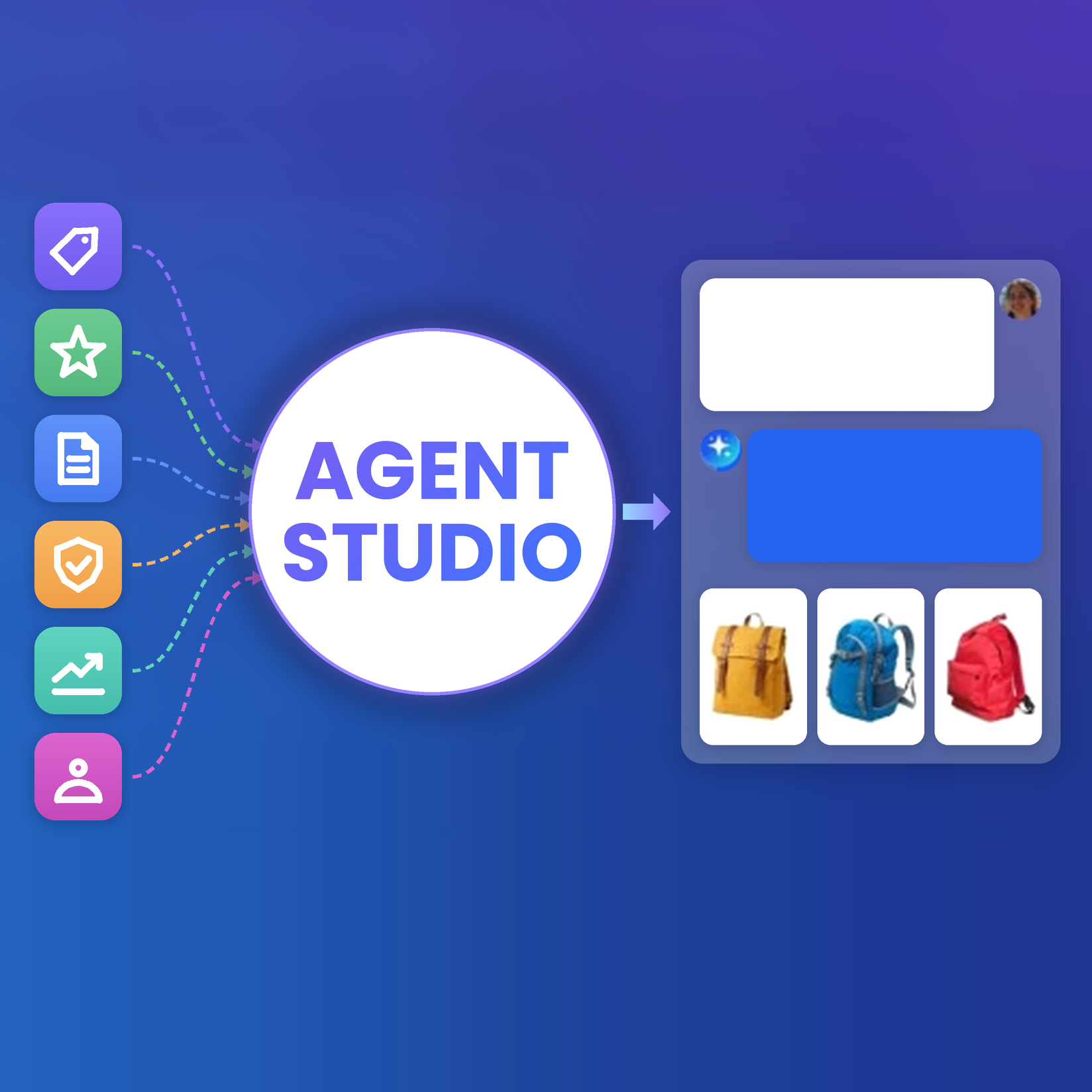
Incremental integration via APIs and middleware can also allow teams to move forward without necessarily rebuilding their entire stack. Algolia's Agent Studio, for example, is designed to work with existing ecommerce platforms and data sources, reducing the integration burden compared to building custom solutions.
Product data quality
AI shopping assistants are only as effective as the product data they rely on. They need:
clear, consistent attributes, beyond just product names and prices
detailed descriptions and accurate categorization
comprehensive specifications
quality images
relationship data (what goes with what)
Organizations often realize their data is messier than they thought, with inconsistent naming conventions, incomplete attributes, outdated information, or missing images.
This ends up significantly limiting how effective an AI shopping assistant can be, so it’s critical for teams to evaluate their data readiness and invest the time in cleaning if need be.
With Algolia, preparing and cleaning your data before deploying an AI shopping assistant is straightforward and ensures your data is consistent, searchable, and optimized for the best end-user experience without needing to preprocess it elsewhere.
Balancing automation with human support
AI assistants perform best on high-frequency, low-ambiguity tasks like product discovery, order status, and routine questions. They struggle with emotionally charged issues, edge cases, or situations requiring judgment, where having humans involved would be better.
So effective implementations follow best practices and use a hybrid model: AI handles what it does well, humans handle the rest, and escalation paths are clear and seamless so customers don’t need to repeat themselves or feel like they’re hitting walls trying to get an answer.
While the promise and cost savings might seem attractive, it’s critical to resist the temptation of letting AI handle everything. The goal isn’t maximum automation, but better outcomes across the journey.
Privacy, security, and compliance
AI shopping assistants often require access to sensitive customer and transaction data, which introduces significant privacy and security obligations. Compliance with standards like PCI DSS, GDPR, and CCPA still applies.
As AI-assisted commerce grows, new frameworks and regulations are emerging to govern agent identity, access, and oversight. Teams should plan for transparency, auditability, and human control from the start rather than treating compliance as an afterthought.
Is your ecommerce brand ready?
Not every organization needs AI shopping assistants immediately, and those that do need to match their approach to their specific situation. At Algolia, we assist customers each day to deploy enterprise-grade, AI retrieval solutions like AI shopping assistants.
There are four key decision-making steps brands should follow when considering AI shopping assistants:
Assess readiness (are we and our data even ready for this?)
Build, buy, or hybrid (should we build this, buy it, or take a hybrid approach?)
Deployment and adoption (how should we approach sequencing the roll-out?)
Vendor evaluation criteria (if we buy or take a hybrid approach, what should we look for?)
Assess readiness
Before evaluating vendors or planning deployments, honestly assess whether your organization has the prerequisites for AI shopping assistant success by going through the following questions and criteria:
Product data quality:
If your product data is messy, fixing it should come first, before AI investment. The assistant will only be as good as the data it works with.
Is your product catalog accurate, complete, and consistently structured?
Can you easily export product data with detailed attributes?
Do you have a process for maintaining data quality over time?
Technical infrastructure:
Understanding your integration constraints helps you scope realistic projects.
Can your systems handle real-time API integration?
Do you have accurate inventory visibility across channels?
Can your checkout process be triggered programmatically?
Customer data and segmentation:
Organizations with rich customer data can offer more personalized experiences from day one.
Do you have purchase history and behavioral data that could power personalization?
Do you understand which customer segments are most likely to adopt AI shopping?
Resources and budget:
Clear ownership and adequate resources are prerequisites for successful deployment.
Do you have budget for implementation and technology costs?
Do you have internal resources for integration, testing, and ongoing management?
Who will own the AI shopping assistant operationally?
Once you understand your AI readiness, the next decision is how much of the AI shopping assistant stack you want to build versus adopt.
Build, buy, or hybrid
Ecommerce teams generally have three paths when implementing an AI shopping assistant. There is no universally “correct” approach. The goal is to match the level of investment and ownership to your organization’s maturity, urgency, and long-term strategy.
Build internally
Building an AI shopping assistant in-house offers maximum control and customization, but comes with significant complexity. Teams are responsible for handling orchestration, retrieval, model management, integrations, testing, and ongoing maintenance.
This approach is best for organizations with strong engineering resources, mature data infrastructure, and a clear reason to own every layer of the experience.
Buy a platform
Adopting an existing AI shopping assistant platform allows teams to move faster and reduce technical risk. These solutions provide pre-built infrastructure for retrieval, orchestration, and integration, enabling quicker experimentation and iteration. For most ecommerce organizations, buying is the fastest way to validate value and reach production.
Hybrid approach (most common)
Many teams combine the two: using a platform as the foundation while customizing logic, workflows, and integrations to fit their business.
This balances speed with flexibility, allowing organizations to focus internal effort on differentiation rather than rebuilding core capabilities.
Deployment and adoption
Whether you build internally, adopt a third-party solution, or take a hybrid approach, AI shopping assistants are most successful when rolled out incrementally.
Teams should prioritize use cases based on impact, complexity, and organizational readiness.
Start with high-impact, low-complexity use cases: product discovery and basic recommendations deliver immediate value without requiring deep integration with order management or payment systems.
Expand to medium-complexity use cases: complete outfit assembly, cart recovery conversations, or personalized reordering require more integration but build on initial capabilities.
Graduate to advanced use cases: autonomous purchasing, price comparison across retailers, or complex returns handling require complex integration and risk management.
Keep in mind that not every organization needs to reach the final stage. The right stopping point depends on your customers, products, and competitive context.
Vendor evaluation criteria
Once you understand your readiness and initial use cases, the next step is selecting technology that aligns with both your current needs and your long-term ambitions.
When evaluating AI shopping assistant solutions, consider these factors:
Speed to deployment: Some solutions enable deployment in days or weeks; others require months of custom development. Faster deployment means faster learning and iteration. Ask vendors for realistic timelines based on organizations similar to yours.
Integration flexibility: Does the solution work with your existing ecommerce platform, PIM, and other systems? What integration effort is required? Solutions with pre-built connectors to common platforms reduce implementation complexity.
LLM flexibility: Can you choose which language models power the assistant? Bring-your-own-LLM capability avoids vendor lock-in and lets you select models based on performance, cost, or compliance requirements. Some solutions lock you into specific AI providers.
Pricing transparency: How is pricing structured? Watch for hidden costs, particularly GenAI markup on underlying model usage. Transparent pricing that scales predictably with usage helps you budget accurately.
Search and retrieval quality: The conversational interface is only as good as the underlying retrieval system. Solutions built on proven search infrastructure tend to deliver more accurate, relevant results than those treating search as an afterthought.
Security and compliance: What security certifications does the vendor hold? How is customer data handled? Can the solution meet your compliance requirements (PCI DSS, GDPR, CCPA, etc.)?
How Algolia enables AI shopping assistants
If you’ve made it this far, you can probably guess that Algolia is able to help with your AI shopping assistant rollout. Algolia provides the infrastructure that makes AI shopping assistants practical in real ecommerce environments.
Instead of building orchestration, retrieval, and relevance from scratch, teams can combine conversational AI with fast, accurate product discovery, real-time data, and business controls on top of an existing search foundation.
This ensures assistants are grounded in what’s actually available, priced correctly, and aligned with merchandising priorities.
With tools like Agent Studio, Algolia supports more agentic shopping experiences while maintaining transparency and control.
Retrieval augmented generation keeps responses accurate and up to date, and standardized interfaces like Algolia’s MCP Server allow AI agents to interact reliably with catalogs, analytics, and ecommerce systems.
The result is faster experimentation, safer deployment, and AI shopping assistants that behave like extensions of the business rather than disconnected chat layers.
Next steps towards AI shopping assistants
AI shopping assistants represent a fundamental shift in how customers discover and purchase products, where natural conversation replaces clunky navigation and where shopping happens through AI-assisted interfaces rather than searching through endless catalogues.
The retailers that succeed in an AI-assisted commerce future will be those that see AI shopping assistants as a beneficial evolution of ecommerce rather than a threat.
And while not every ecommerce brand may be a great fit for AI shopping assistants, those that are should assess their readiness, evaluate ideal use cases to start with, and partner with a vendor that can help deliver AI shopping assistants that drive better experiences for customers and better business outcomes for the brand.
Ready to evaluate AI shopping assistants for your business? Request a demo to see how Algolia can help you build and deploy AI-powered shopping experiences that drive results.


.webp)











.jpg)



%20(2).svg)